Imagine, Around 1453, merchants of Venice and Genoa monopolized the trade between Europe and Asia and refused to let any other West European nation (Spain, Portugal) to have any share in the trade through these old routes.
But the West European states wanted to break the trade monopoly. They searched for new and safer sea routes to India and East Indies (Spice Islands in Indonesia). They were well equipped and advanced in ship-building and the science of navigation. Also they got great spirit of adventure from Renaissance.
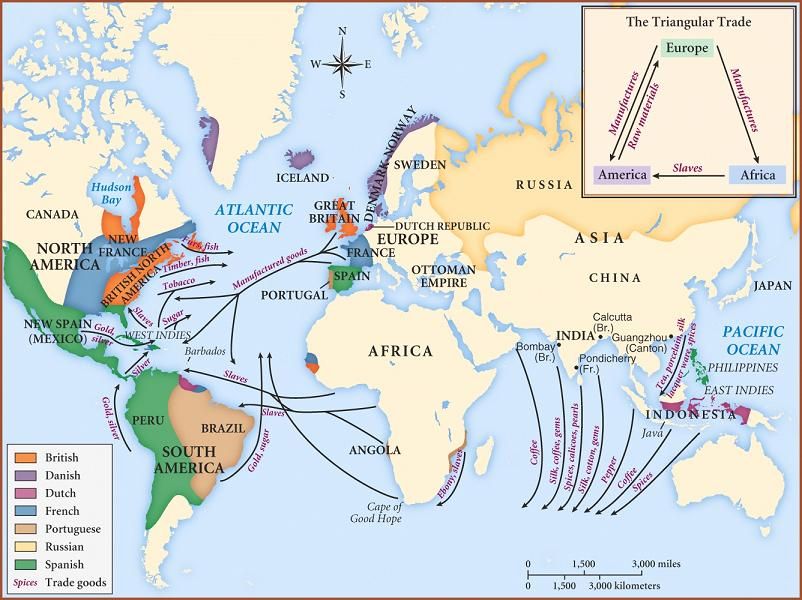
Seamen of Spain and Portugal took the first steps and stared great geographical discoveries. In 1492, Columbus of Spain set out to reach India and found America instead. In 1498, Vasco da Gama of Portugal discovered a new all-sea route from Europe to India. He sailed round Africa via the Cape of Good Hope and reached Calicut (city in Kerala). He returned with a cargo which sold for 60 times the cost of his voyage. 🤯
In the 16th century, European merchants and soldiers started penetrating and taking control of Asian lands. Portuguese used force with trade, so they had domination over the seas and entire Asian coast. They established trading settlements at Cochin, Goa, Daman and Diu. By threatening Mughal shipping, they got many trading concessions.
They seized Indian territories on coast and waged constant war to expand their trade and dominion and safeguard their trade monopoly from other Europeans. They showed inhuman cruelties, lawlessness and even piracy and plunder. But they kept their possession in India for over a century because of the control over the seas, strict discipline and south India was outside the influence of the Mughals.
In the latter half of the 16th century, England, France and others were all growing power and after a fierce struggle they broke the Portuguese monopoly and were able to use the Cape of Good Hope route to India and joined the race over empire in the East. In the end, Dutch gained control over Indonesia and British over India, Sri Lanka and Malaya.
In 1602, the Dutch East India Company formed with powers to make war, conclude treaties, acquire territories and build fortresses. But they were more interested in spice of Indonesia than India and they did capture it and kicked out Portuguese and prevented British invasion there. They even established trading depots in West India (at Surat, Broach, Cambay, Ahmedabad, Gujarat), Cochin in Kerala, Nagapatam in Madras, Masulipatam in Andhra, Chinsura in Bengal, Patna in Bihar and Agra in Uttar Pradesh. Later in 1658, they conquered Sri Lanka from the Portuguese.
Looking greedily at all these Asian trade, the success of Portuguese, the rich cargos of spices, calicoes, silk, gold, pearls, drugs, porcelain and ebony which were highly profitable, a company to trade in the East was formed in 1599 under the auspices of a group of Merchant Adventurers. On 31st December 1600, the company, popularly known as the East India Company, was granted a royal charter and an exclusive privilege to trade in the East by Queen Elizabeth. But, From the beginning, it was linked with the monarchy: Queen Elizabeth (1558-1603) was one of the shareholders of the company.
In 1608, it decided to open a factory (the name given at the time to a trading depot), at Surat on the West coast of India and sent Captain Hawkins to Jahangir’s Court to obtain Royal favours. Initially, Hawkins was received in a friendly manner. He was given a mansab of 400 and a jagir. Later, he was expelled from Agra as a result of Portuguese intrigue.
This convinced the English of the need to overcome Portuguese influence at the Mughal Court if they were to obtain any concessions from the Imperial Government. They defeated a Portuguese naval squadron at Swally near Surat in 1612 and then again in 1614. These victories led the Mughals to hope that in view of their naval weakness they could use the English to counter the Portuguese on the sea. Moreover, the Indian merchants would certainly benefit by competition among their foreign buyers. Consequently, the English Company was given permission by a Royal farman to open factories at several places on the west coast.
But, The English were not satisfied with this concession. In 1615 their ambassador Sir Thomas Roe reached the Mughal Court. They also exerted pressure on the Mughal authorities by taking advantage of India’s naval weakness and harassing Indian traders and shipping to the Red Sea and to Mecca. Thus, combining entreaties with threats, Roe succeeded in getting an Imperial farman to trade and establish factories in all parts of the Mughal Empire. Roe’s success further angered the Portuguese and a fierce naval battle between the two countries began in 1620. It ended in English victory.
Hostilities between the two came to an end in 1630. In 1662 the Portuguese gave the Island of Bombay to King Charles II of England as dowry-for marrying a Portuguese Princess. Eventually, the Portuguese lost alt their possessions in India except Goa, Din and Daman. The intermittent war in India between the two powers, which had begun in 1654, ended in 1667, when the English gave up all claims to Indonesia while the Dutch agreed to leave alone the English settlements in India.
Episode 2: How did they grow so much influence over India, 1600 – 1714
Coming soon. Save the link.
 suparnom